
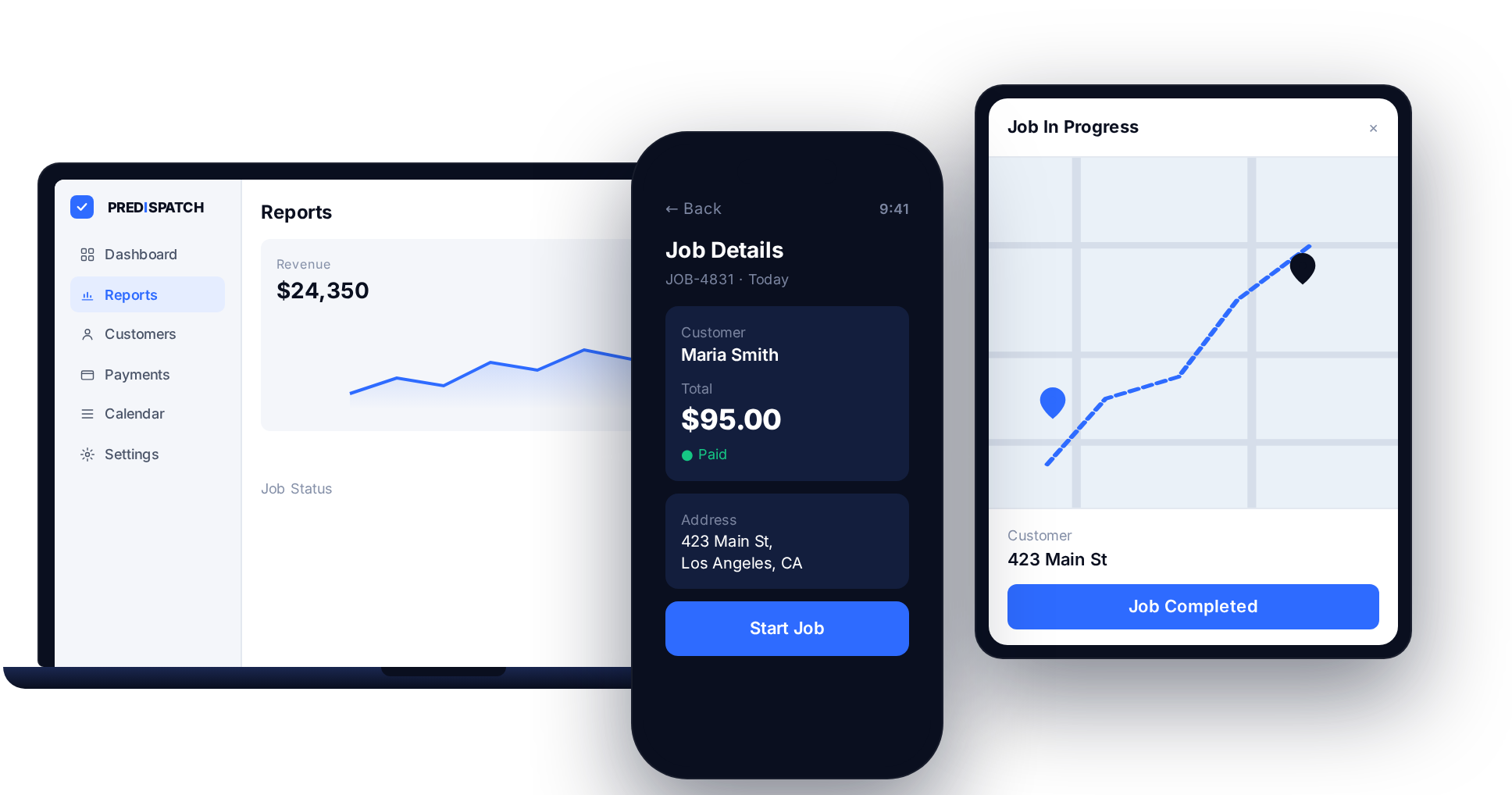
The 4-step workflow
Collect-before-dispatch sounds complicated. Implemented well, it takes a customer 30-60 seconds and a dispatcher 10 keystrokes. Here's the full workflow.
Capture the job + customer info
Dispatcher takes the call, enters address, service type, customer phone number. Standard intake.
Trigger the payment link
One click in the dispatch software sends an SMS to the customer's phone with a secure Stripe-hosted payment page. Link includes the service-call fee, the shop's branding, and Apple Pay / Google Pay / card options.
Customer pays
Customer taps the link, picks Apple Pay (fastest), confirms with Face ID, done. The whole flow on their phone takes about 25 seconds. Stripe handles security and PCI compliance.
Job promotes to "paid"
Webhook from Stripe hits the dispatch board the instant payment clears. Job moves from "pending" to "paid." Tech can now be dispatched.
The gate
The dispatch board enforces the rule: jobs cannot be marked "dispatched" until status reaches "paid." This is the cultural and technical enforcement that makes the workflow stick.
The phone script
The script matters as much as the technology. Use this template, adapted to your trade:
"Got it — I can have a tech to you in [X] minutes. The service-call fee is $[amount]. I'm texting you a secure payment link right now — tap it, pay with Apple Pay or a card, and your tech rolls. The whole thing takes about a minute. Sound good?"
Three rules:
- State the fee in dollars, not "the service-call fee." "$89" is concrete. "Our service-call fee" is vague.
- Mention Apple Pay. 60%+ of customers use it; mentioning it lowers anxiety.
- End on a question. "Sound good?" gets a verbal yes before the link arrives. Verbal yes plus paid link = locked-in commitment.
Deposit amounts by trade
| Trade | Recommended deposit | Notes |
|---|---|---|
| Locksmith | $45 | Lower deposit; full $89 applied on-site |
| HVAC (emergency) | $125 | Higher because after-hours rates are higher |
| Plumbing (emergency) | $89 | Full service-call fee |
| Electrical (emergency) | $125 | Full service-call fee |
| Garage door | $75 | Mid-range deposit |
| Towing (retail) | $95 | Carve out motor-club work |
| Roadside assistance | $65 | Lower friction for distressed customers |
| Appliance repair | $89 | Standard service-call |
The carve-outs to set up on day one
Three categories should be exempt from the deposit gate:
- Motor-club / insurance / fleet contracts. Bill directly per contract. Different payment terms.
- Repeat customers with 3+ completed jobs and good history. They've earned the trust.
- Safety emergencies. Child in car, gas leak, electrical fire. Dispatch first, collect later — every time.
Refund policy template
Publish this on your site and quote it on the phone if asked:
"If we cancel or can't make the appointment, you get a full refund automatically the same day. If you cancel before the tech is dispatched, full refund. If you cancel after the tech is en-route, the trip fee covers the work already done. Refunds hit your card in 5-10 business days."
This script reads as fair to 95% of customers. The 5% who'd dispute either way will dispute either way; you can't optimize for them.
What changes in 30 days
The whole workflow, built in.
PreDispatch handles dispatch-board enforcement, Stripe links, refunds, and trade-specific deposit amounts natively. Free 14-day trial.
FAQs
Do I need a Stripe account?
Yes if you're using PreDispatch (we use Stripe under the hood). Setup is 5 minutes; standard Stripe rates apply (2.9% + 30¢ for cards).
Can I use Square instead?
PreDispatch is Stripe-only. Square works for manual payment-link workflows but doesn't integrate to PreDispatch's dispatch gate.
What about international customers?
Stripe supports international cards. Workflow works the same. Currency conversion handled by Stripe.
How long does the payment link stay valid?
Default 4 hours. After that the dispatcher reissues. Most customers pay within 5 minutes.