
Key Takeaways
Trust is the strongest answer to locksmith scams. Clear pricing, verifiable credentials, reliable communication, and a consistent local presence give customers reasons to choose a legitimate provider when they are under pressure.
- Publish realistic service call fees and pricing ranges before dispatch.
- Make your license, insurance, identity, and service area easy to verify.
- Use local search content and genuine reviews to build credibility.
- Confirm technician details, arrival expectations, and job scope clearly.
- Track cancellations and complaints so your process keeps improving.
Understand how locksmith scams damage customer trust
Lockouts are stressful, and customers often choose the first result that appears to offer immediate help. That makes misleading listings and vague pricing especially damaging. When a customer is surprised by a large bill or pressured to approve unnecessary work, the harm extends beyond that single transaction. It makes honest locksmiths look suspicious by association.
Common scam tactics in emergency locksmith calls
A common pattern begins with a low advertised price and ends with a much higher demand after the technician arrives. Fake or misleading listings may use local-sounding names, several phone numbers, or photographs that do not clearly identify the actual business. Some operators also use urgency to discourage questions about licensing, address, payment, or the work being proposed. A clear explanation of locksmith scams can help business owners understand how these tactics confuse customers before they ever make contact.
The problem is not limited to one kind of lockout. A person locked out of a vehicle, home, or workplace may be tired, worried, or responsible for children or employees. In that moment, a promise of fast service can outweigh sensible verification unless a legitimate company makes verification simple.
Warning signs customers use to identify rogue providers
Customers are increasingly alert to details that once seemed minor. They may look for a physical address, a local phone number, technician identification, a marked vehicle, and reviews that describe specific experiences rather than repeating generic praise. They may also ask whether the person arriving is an employee or an outside contractor and whether the quoted price includes travel and service fees.
This is why educational material such as a locksmith scam warning guide belongs on a legitimate company website. It gives customers useful questions to ask without forcing them to accept a sales pitch. The more plainly a business answers those questions, the less room there is for confusion.
How inflated pricing and bait-and-switch quotes affect the market
Bait-and-switch pricing distorts the market in two directions. The advertised price becomes unrealistically low, while honest companies appear expensive because they show the real cost of travel, labor, equipment, and potential parts. Customers may then call several businesses based only on the first number they see, even when that number does not describe the likely job.
The result is wasted time for customers and dispatchers, more abandoned calls, and a harder conversation about value. Legitimate locksmiths can counter that pattern by explaining the variables behind a range and stating what would cause the price to change. A quote does not need to be the lowest number; it needs to be credible.
Why legitimate locksmiths must address fear and urgency
A rushed customer does not need a lecture. They need a calm answer, a clear next step, and enough information to decide whether they feel safe proceeding. Staff should acknowledge the urgency, ask only the questions needed to understand the call, and avoid implying that hesitation will make the situation worse.
A useful principle is simple: clarity reduces pressure. When customers know who is coming, what the initial charge covers, and how approval works, they can make a decision without feeling trapped. That experience is a practical way to compete with locksmith scammers and win customers through trust.
Build a transparent pricing and booking process
A transparent booking process starts before a technician leaves the shop. It should tell the customer what the service call costs, what information the business needs, and when additional work might change the estimate. The goal is not to predict every job perfectly; it is to remove avoidable surprises. Clear records also help the office and technician give the same answer.
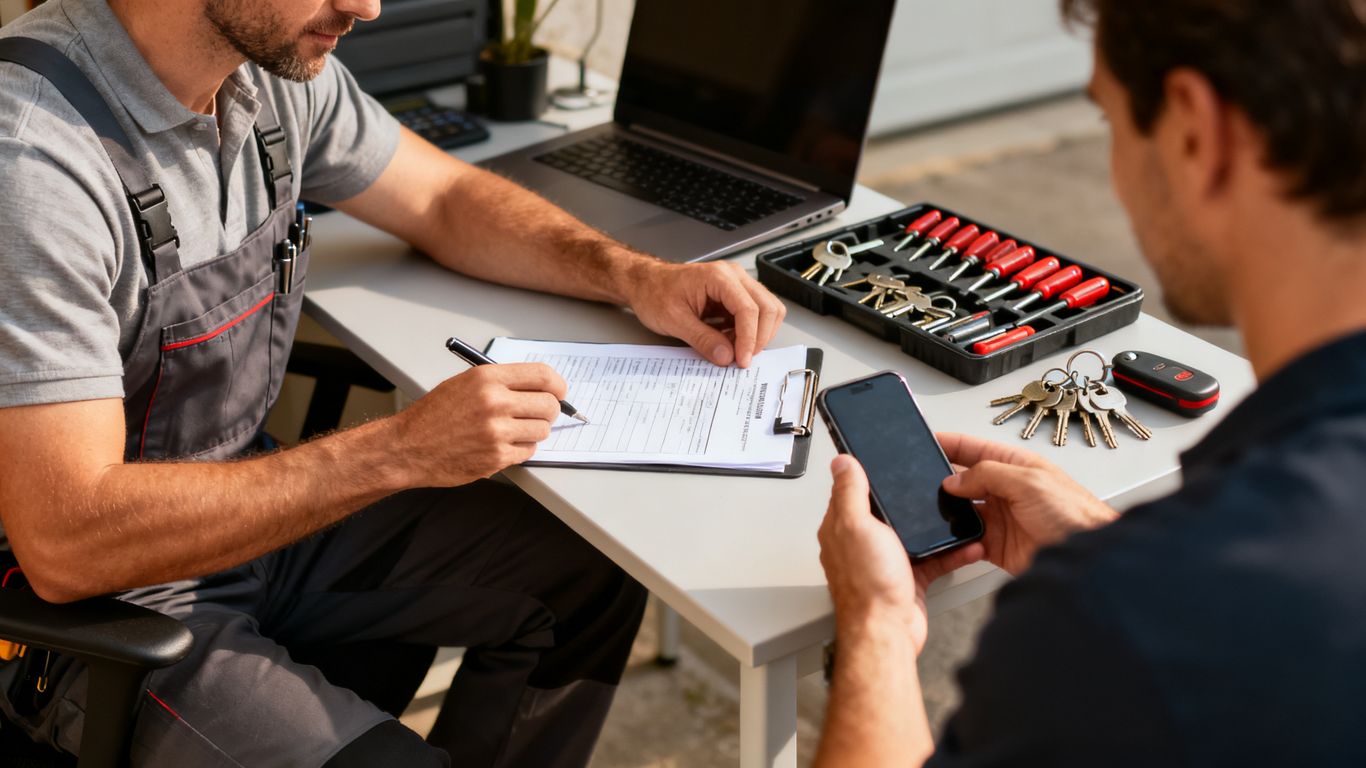
When a company collects a payment or deposit before dispatch, it should explain that step plainly and provide a receipt or confirmation. PreDispatch is designed to help service companies collect payments or deposits before dispatching technicians, which fits naturally into a booking process built around commitment and clear expectations.
Publish service call fees and pricing ranges
A service page should show whether the customer pays a dispatch fee, travel fee, diagnostic charge, or minimum labor amount. If prices vary by location, time, lock type, or access method, say so in ordinary language. A range is more useful than a teaser price that applies to almost nobody.
The published range should be reviewed whenever fuel, labor, parts, or coverage areas change. It should also match what call handlers actually say. A mismatch between a website and a phone quote can feel like a bait-and-switch even when the business did not intend to mislead.
Explain what is included before dispatch
Before booking, describe the first visit in practical terms. Customers should know whether the technician will assess the lock, attempt non-destructive entry where appropriate, provide an updated estimate for replacement work, and accept the payment methods advertised by the office. Do not promise an outcome that depends on the lock, vehicle, property, or site conditions.
The same explanation should appear in the confirmation message. Repetition is useful during an emergency because customers may not remember every detail from a short phone call. It also gives technicians a clean starting point when they arrive.
Use written estimates and customer approval
A written estimate creates a shared reference point. It can include the service requested, the initial fee, the expected labor or parts range, taxes if applicable, and the approval required before work beyond the original scope begins. The document should be easy to read on a phone rather than hidden in dense terms.
The booking record should show when the estimate was sent and whether the customer accepted it. A practical estimate workflow usually includes these steps:
- Record the customer’s location and requested service.
- Send the initial fee and expected range in writing.
- Identify the technician or team assigned to the call.
- Obtain approval before adding work outside the original scope.
After the list is complete, the office can refer back to it when a customer has questions. That small discipline helps prevent disagreements between what was promised and what was performed.
Handle changes when the job requires additional work
Some jobs genuinely change after inspection. A damaged cylinder, inaccessible mechanism, or security concern may require additional labor or parts, but the customer should hear that explanation before the work proceeds. The technician should describe the problem, state the revised price, and wait for approval unless there is an immediate safety issue that requires a different response.
Keep the original estimate and revised approval together. If the customer declines, document what was offered and what was completed. Fair handling of changes protects the customer while giving the business a defensible record.
Strengthen your local SEO presence
Local search is often the first place a locked-out customer looks for help. A legitimate locksmith therefore needs more than a website; it needs accurate, useful information wherever customers encounter the business. Search visibility matters, but credibility determines whether a person calls, books, and recommends the company. Every listing and page should reinforce the same identity.

Do not treat search optimization as a contest to make the biggest promise. Treat it as an opportunity to answer the questions a nervous customer has before choosing a provider. That approach creates better leads and makes the business easier to verify.
Optimize your Google Business Profile
Use the exact business name, real service area, current phone number, hours, and address where customers can visit or correspondence can be received. Add authentic photographs and keep holiday or emergency hours current. Categories and services should describe what the business actually does rather than every adjacent service someone might search.
Review the profile regularly for duplicate listings, incorrect phone numbers, and edits that change the business identity. Customers should not have to decide which of several similar profiles is real.
Create service pages for emergency locksmith searches
A useful service page answers who the service is for, where it is available, what the first visit includes, and how pricing is handled. Separate pages for vehicle lockouts, home lockouts, rekeying, and other genuine services can be helpful when each page contains original, specific information. Avoid thin pages that simply swap one city name for another.
Include questions customers ask in a hurry: whether identification is provided, how arrival updates work, what information to have ready, and whether written approval is required for added work. This makes the page useful even when the visitor is not ready to call immediately.
Target nearby cities and service areas responsibly
Name only areas the team can actually reach within its normal operating model. Explain whether coverage changes after hours and whether travel fees vary by distance. A page that implies a local storefront where none exists may produce a call, but it weakens trust as soon as the customer tries to verify the address.
Local relevance can come from real service history, community relationships, and practical directions, not invented neighborhood claims. Accurate coverage also helps dispatchers avoid promising an arrival that the team cannot meet.
Earn reviews that demonstrate reliability and value
Ask for feedback after completed work, but do not script praise or offer incentives that distort the customer’s opinion. A strong review often mentions communication, arrival updates, explanation of the estimate, workmanship, or how a change was handled. Those details are more persuasive than a high star count without context.
Respond to reviews consistently and invite private follow-up when a problem remains. A locksmith scam prevention checklist can also give customers a useful standard for judging reviews, addresses, and upfront pricing before they need service.
Prove that your locksmith business is legitimate
Trust grows when customers can verify a company without making several calls. Credentials, contact details, photographs, and business records should agree with one another. The standard varies by jurisdiction, so a locksmith should publish the credentials required where it operates and avoid displaying certifications that do not apply. Verification is part of the service, not a defensive afterthought.
Display licensing, insurance, and professional credentials
Place current license or registration details where customers can find them, along with insurance information and relevant trade credentials. Explain which authority issued each credential and whether it applies to the business, the individual technician, or both. Never imply that a voluntary credential replaces a legal requirement.
Staff should know how to answer verification questions without becoming defensive. If a customer wants to check a registration independently, provide the issuing authority or official lookup route when appropriate.
Use consistent business information across directories
The business name, phone number, address, hours, and website should match across directories and social profiles. Inconsistencies can look like a network of unrelated listings, particularly when several numbers route to one call center. Remove old profiles when possible and correct duplicate or inaccurate entries.
Keep a simple directory record with the date each listing was checked. This is ordinary maintenance, but it supports both local visibility and customer confidence.
Show real photos of technicians, vehicles, and equipment
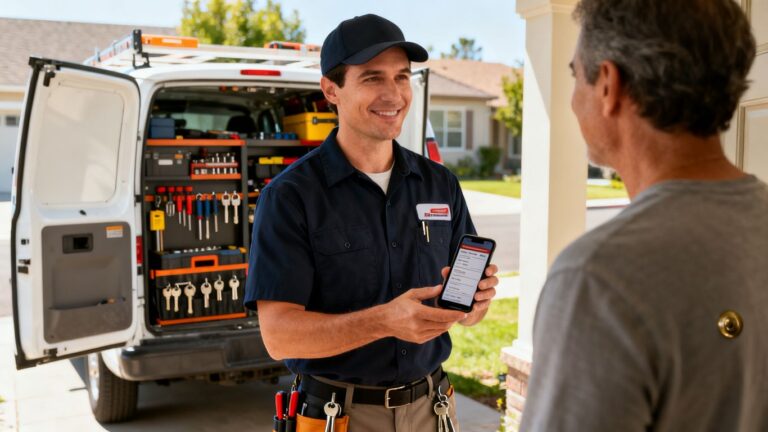
Use current photographs of the people and equipment customers are likely to see. A technician in a uniform beside a recognizable service vehicle gives the customer something to compare when help arrives. Photos should be honest, current, and free from borrowed stock imagery that suggests a team or facility the business does not have.
Images can also show organized tools, protective equipment, and clean work practices. They do not need to look expensive; they need to look real.
Make your company identity easy to verify
Give customers one consistent path to confirm the business: a working phone number, a real address or clearly described mobile operation, a domain that matches the company name, and a person who can explain the booking. If the company uses subcontractors, state that accurately and explain how technician identity and responsibility are handled.
A customer should be able to compare the listing, confirmation, vehicle, and invoice without finding unexplained differences. That continuity is more convincing than exaggerated claims about being the best.
Deliver a customer experience scammers cannot match
A trustworthy experience is built from small moments, especially between the first call and the technician’s arrival. Customers want to know that the person answering understands the problem and that the person dispatched is connected to the business they contacted. Reliability does not require elaborate language. It requires follow-through.

The office should design handoffs deliberately. Every message, status update, and approval should reduce uncertainty rather than create another question.
Answer urgent calls quickly and professionally
Use a greeting that identifies the business and sets a calm tone. Ask for the location, type of lockout, immediate safety concerns, and the customer’s preferred contact method. If the team cannot serve the area or timeframe, say so promptly and avoid keeping the caller in a queue that will not lead to help.
A short call script can keep service consistent without making the conversation sound robotic. It should prompt the employee to explain fees, availability, and the next step before asking for payment or dispatch approval.
Confirm technician details before arrival
Send the customer the technician’s name, a description of the vehicle, and a contact number or safe way to confirm arrival. If the assignment changes, send an updated notice rather than leaving the customer to wonder whether an unfamiliar person is legitimate. These details also help customers avoid opening a door or approaching a vehicle they cannot identify.
The confirmation should repeat the service address and the agreed starting price or range. That gives both sides a final chance to correct a misunderstanding.
Set expectations for arrival times and job duration
Give an arrival window instead of an overly precise promise. Explain what might cause a delay, such as traffic, weather, or a longer preceding job, and send an update when the estimate changes. Once on site, the technician can explain how long the assessment and likely work may take without guaranteeing a result before inspecting the lock.
When a deposit or payment is collected before dispatch, PreDispatch supports the operational goal of securing that payment before a technician is sent. The customer-facing message still needs to explain the charge and cancellation terms in plain language.
Clear expectations reduce avoidable calls to the office and make delays easier to handle. They also show that the business respects the customer’s time.
Follow up after service to resolve concerns
Send an invoice or receipt that describes the work completed and lists approved additional charges separately. A short follow-up message can ask whether the customer received the documentation and knows whom to contact with a concern. Keep the invitation genuine; the purpose is to resolve issues, not to pressure someone into leaving praise.
When a complaint arrives, route it to a person with authority to investigate. A fast, documented response can preserve a relationship even when the original service did not go perfectly.
Use ethical marketing to differentiate your services
Ethical marketing does not mean hiding from the scam problem. It means helping customers make a sound decision without claiming that every other provider is dishonest. A business can explain its own standards, show its process, and let the contrast speak for itself. That style is persuasive because it remains useful even after the emergency has passed.
Write helpful content about avoiding locksmith scams
Create articles, short videos, and FAQs that explain how to compare quotes, verify a technician, and recognize a listing that lacks a real identity. Use examples carefully and avoid sensational claims that cannot be supported. Content should tell readers what to ask before dispatch, not merely warn them to be afraid.
A guide about avoiding scams can also include a printable checklist or a phone-call script. Helpful content earns attention before a customer needs a locksmith and may be shared by local property managers or families.
Explain your process without making unsupported accusations
Describe what your company does: how it quotes, how it confirms identity, how it handles additional work, and how it follows up. Do not name or imply a specific rival is fraudulent unless there is a clear legal and factual basis for doing so. General education protects the audience while keeping the business professional.
Use verifiable language such as “we provide” and “we ask for approval.” Avoid absolute promises about arrival time, price, or outcome when conditions can vary.
Compare value instead of competing only on price
Price is part of the decision, but customers also weigh responsiveness, clear documentation, safe work, payment options, and confidence that the technician will stand behind the job. Explain those elements next to the price rather than burying them in fine print. A realistic quote can feel more affordable than a low teaser followed by a surprise bill.
This is also where a business can explain deposits or prepaid dispatch fairly. PreDispatch is built around collecting payments or deposits before dispatch, so the company should pair that process with clear terms, receipts, and a straightforward cancellation policy.
Partner with local businesses and community organizations
Property managers, vehicle fleets, real estate offices, schools, and neighborhood groups often need a dependable locksmith before an emergency occurs. Offer practical education, contact information, and a clear service process rather than asking partners to make unsupported endorsements. A workshop on verifying emergency contractors can be useful on its own.
These relationships can also reveal recurring problems in a service area. Listening to them may lead to better coverage information, clearer after-hours instructions, and more useful content.
Measure performance and protect your reputation
Trust should be visible in operating data, not treated only as a branding idea. Track what happens from the first call through payment, dispatch, completion, and review. A simple weekly report can reveal whether customers are abandoning the process because of price, unclear terms, slow response, or a gap in coverage. Measurement makes improvement specific.
Track calls, booked jobs, cancellations, and close rates
Record call source, requested service, quoted range, booking result, cancellation reason, dispatch status, and completion. Compare these measures by time of day, service type, and area without assuming that one number explains everything. A high cancellation rate after booking may point to unclear payment terms, while a low close rate may begin with poor qualification or slow callbacks.
PreDispatch can be part of this review because it helps businesses collect payments or deposits before dispatching technicians. Examine whether that step filters low-commitment bookings, and also check whether customers understand the terms before paying. The purpose is a more dependable process, not pressure for its own sake.
Monitor review trends and customer complaints
Read reviews for repeated themes rather than reacting only to star ratings. Group comments around arrival communication, price clarity, workmanship, technician behavior, and billing. Review private complaints in the same way, since unresolved concerns may never become public but can still indicate a process failure.
A monthly trend is usually more useful than one difficult review. Still, a single complaint involving safety, misleading pricing, or unauthorized work deserves immediate attention.
Respond to negative feedback with documented solutions
A public reply should acknowledge the concern, avoid exposing private details, and invite the customer to continue through an appropriate channel. Internally, preserve the booking record, estimate, approvals, technician notes, photographs, and invoice. Then decide what remedy is justified by the facts.
Do not argue about a customer’s character or accuse them of bad faith. A calm response that leads to a documented investigation is more credible to the reviewer and to people reading later.
Update pricing, training, and marketing based on results
Use the evidence to make narrow changes. If customers repeatedly ask whether travel is included, rewrite the quote and confirmation. If technicians struggle to explain added work, train them with examples and require approval documentation. If a service page attracts calls from outside the coverage area, revise the location language instead of accepting bookings the team cannot fulfill.
Review the changes after a defined period and keep the ones that improve clarity, completed jobs, and customer feedback. Trust is maintained through repeated operational choices, not a single campaign.
Conclusion
How to Compete With Locksmith Scammers comes down to making the honest choice easy to recognize: show the real price, verify the real business, communicate before and during the visit, and record what was approved. When those habits shape the entire customer journey, trust becomes a practical operating advantage rather than a slogan.
Frequently Asked Questions
What is the clearest warning sign of a locksmith scam?
An unusually low price that changes sharply after arrival is a major warning sign. Customers should also question providers who cannot identify the technician, explain the full starting charge, or provide a verifiable business identity.
Should a locksmith publish exact prices online?
Publish service call fees and realistic pricing ranges whenever possible. If the final cost depends on inspection, explain the factors that affect it and state that additional work requires customer approval.
How can customers verify a locksmith before booking?
They can check licensing or registration requirements, confirm the address and phone number, read detailed reviews, ask for technician details, and request a written estimate that includes travel or service charges.
Why do genuine businesses sometimes use price ranges?
The condition of a lock, access method, location, time of service, and required parts may not be known until inspection. A range can be honest when the business explains what it includes and what could change it.
Are deposits or prepaid dispatch fees trustworthy?
They can be reasonable when the amount, purpose, cancellation terms, and refund conditions are explained before payment. Customers should receive written confirmation and know how to contact the business with questions.
What should a customer do if the price changes on site?
Ask the technician to explain the reason, provide the revised price in writing, and wait to approve the added work. If the explanation or pressure feels unsafe, the customer can decline and seek help from another provider.
How can a locksmith recover from a negative review?
Investigate the booking and service records, respond calmly without revealing private information, and offer a practical resolution when the facts support one. Then correct the process that caused the complaint so the same issue is less likely to recur.